The useful takeaway
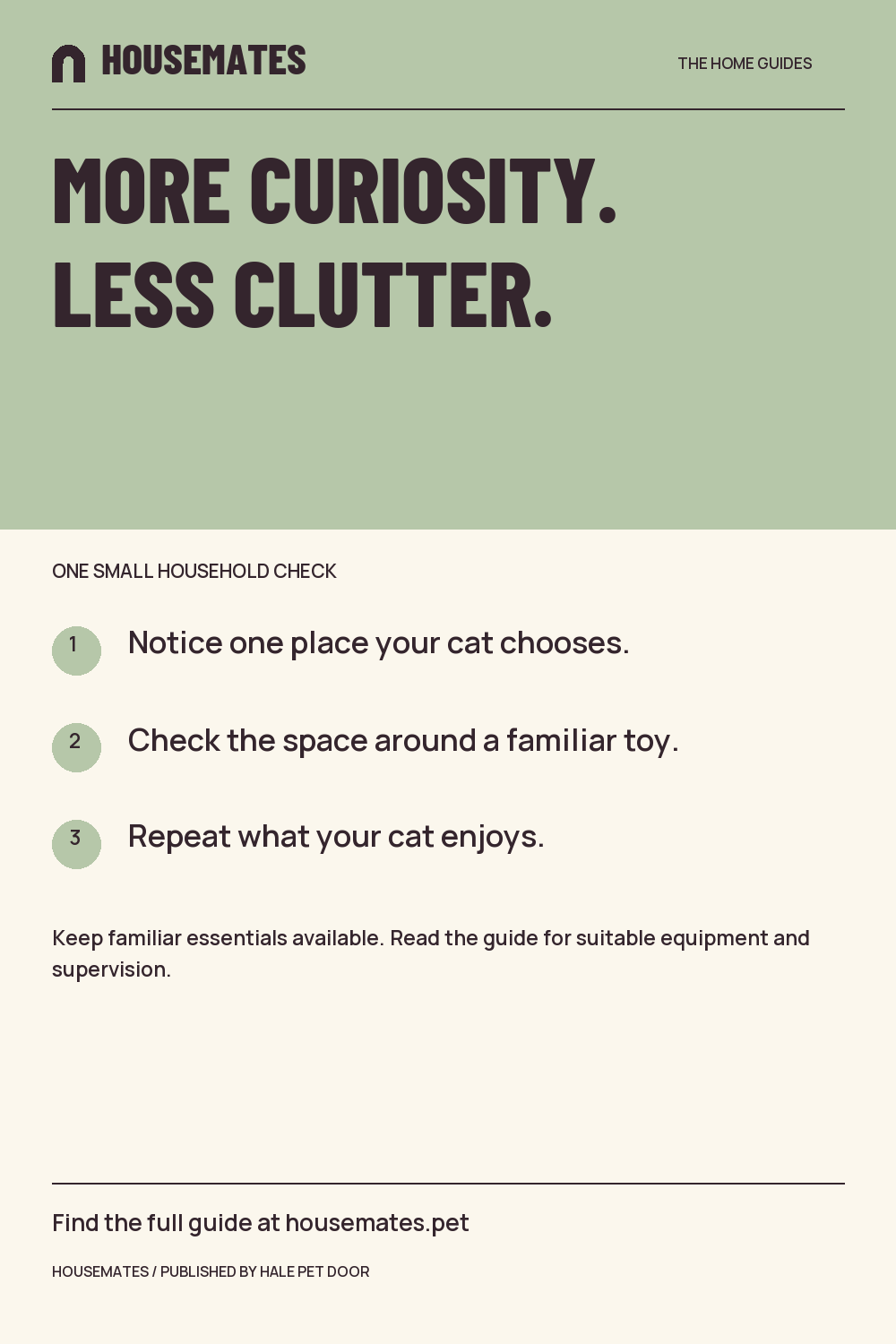
Start with one choice your cat can use today: a familiar game, a suitable scratching spot, a comfortable view or an undisturbed retreat. Keep the useful things within reach.
What counts as indoor cat enrichment?
Enrichment gives a cat opportunities to do things such as stalk, scratch, watch, explore and retreat. It includes how a room works, the activities available and interactions the cat chooses. Ohio State’s indoor-cat resource guide includes resting areas, perches, scratching, toys and refuge alongside essential resources.
For a small home, begin with an ordinary evening: where does your cat settle, which route does it take, and what seems to interrupt it? A scratcher behind the vacuum may be present but awkward to use. A resting place can be comfortable until someone needs the chair. These are useful clues about placement before you buy anything.
Our ideas and room checks below are original household planning examples based on the linked environmental guidance. They are choices to adapt, not a required shopping list, an exercise prescription or treatment for a behavior problem.
Choose an idea that fits your room
| If your home has... | A practical first option | Check before trying it |
|---|---|---|
| Very little free floor space | Clear an existing suitable viewing spot | Stable support, an accessible route and a secure window |
| One busy shared living room | Protect a quiet retreat at the edge of household activity | People and other pets can leave it undisturbed |
| A collection of ignored toys | Offer one familiar toy during supervised play | Condition, movement and whether the cat chooses to engage |
| A scratcher that never gets used | Compare its position and surface with the cat’s preference | Stability, orientation and enough room to stretch |
| More than one cat | Check whether each cat can reach a preferred resource | Another cat cannot block the only approach |
The table helps you choose a starting point; it does not certify a setup. Keep food, water, litter and established rest spaces available while making an optional change. For litter access in a tight layout, use our small-apartment placement guide.
1. Make a familiar game easier to enjoy
Ohio State’s toy guidance describes the appeal of stalking and catching moving objects. Try a familiar cat toy in a clear area, moving it away from the cat rather than pushing it into its face. Give the cat room to watch, approach or leave.
Put away wand toys and strings after supervised play, and check for loose or damaged parts. In a compact living room, decide where the toy will travel before starting; keep the route clear of bowls, sharp edges and people’s feet. Stop if the setup is creating frustration or avoidance.
2. Rotate a few toys, keep a favorite
A rotation can use things you already own. Keep a small selection available and store other suitable toys securely; bring an old option back another day. Ohio State advises variety while leaving a strongly preferred toy available.
Try a simple cupboard arrangement: one space for checked toys ready to use, another for anything damaged or awaiting a decision. This is our household suggestion, not a care rule. Do not put an unsafe toy back into circulation because it is a favorite, or leave a toy out if its instructions require supervision.
3. Improve an existing window view
A suitable perch lets a cat observe its surroundings from above. Ohio State’s perch guide includes existing sturdy furniture as an option. Buying a tall cat tree is not the only possible starting point.
Check the entire route up and down, the stability of the furniture and the individual cat’s ability to use it. Follow the manufacturer’s instructions for any fitted perch. Keep the window secure and cords out of reach; this guide does not approve an open window, balcony or DIY fixture. Let the cat choose whether to use the spot, and keep a quieter alternative available.
4. Match the scratcher to the cat
Notice the surface, angle and location the cat already chooses. Ohio State’s scratching guidance explains that some cats prefer upright surfaces while others use horizontal ones. A suitable scratcher needs to stay steady and allow a comfortable stretch.
Before replacing an unused scratcher, check whether it has been squeezed into an inconvenient gap. Our practical suggestion is to compare the approach with the cat’s usual route, then consider a better position for an appropriate product. Keep the surrounding path usable. A small footprint is only helpful if the cat can actually use the surface.
5. Offer a simple hiding choice
An undisturbed retreat is part of an enriched home, too. Ohio State describes refuge as somewhere a cat can withdraw from household activity without being bothered by people or other pets.
A suitable open cardboard box or familiar covered bed may offer a choice without a large piece of furniture. For a box, remove packing material, tape the cat might chew, staples and handles; supervise its introduction and remove it if the cat chews or swallows pieces. Place it somewhere the household can leave alone. Do not reach into it to make the cat participate in a game.
6. Make quiet space usable during busy hours
Walk the room at the time everyone usually comes home. Is a bag placed over the cat’s route? Does a chair pulled out for dinner block the retreat? Mark that one conflict and agree where the human item will go instead. This is an original room-use exercise: the useful result is a specific household agreement.
For more than one cat, look at access separately for each animal. A resource count alone does not show who can reach what. If one cat is repeatedly guarding routes or another is avoiding essentials, seek qualified advice. Adding objects to the same contested corner may leave the underlying access problem unchanged.
Try a simple seven-day rotation
Ohio State recommends starting with one manageable change and letting cats explore new structures at their own pace. This optional Housemates plan gives you a way to organize that approach. Days are prompts, not deadlines; repeat or skip them as appropriate.
- Day 1: note the cat’s current favorite play, watching and resting places.
- Day 2: try one familiar supervised game in a clear space.
- Day 3: check the comfort and approach to an existing viewing spot.
- Day 4: compare the scratcher’s position with the cat’s preferences.
- Day 5: offer one suitable hiding choice if the room needs it.
- Day 6: repeat the option the cat chose most readily.
- Day 7: keep what worked and remove clutter or an unwanted optional addition.
For each try, write only what you offered, what the cat did and what you would change. “Watched, approached, then left” is a useful observation. It does not require calling the cat bored, stubborn or ungrateful. Keep the familiar essentials in place throughout.
Common questions before you rearrange things
Do I need to buy new toys?
Start by reviewing the safe, suitable things you already have and the space to use them. The comparison above may point to placement or a household routine before a purchase. Replace damaged equipment and follow product supervision requirements.
How long should a play session last?
This guide does not set one duration for every cat. Offer an appropriate activity, watch the response and allow the cat to stop. Ask your veterinary team about an individual plan when age, mobility or health affects activity.
Can I leave enrichment out while I am away?
Leave only items suitable for that individual cat and for unsupervised use according to their instructions. Put away strings, wand toys and anything with a known chewing or swallowing risk. A secure comfortable view or resting choice may be more suitable than an unattended interactive toy.
What if this is a newly adopted cat?
Begin with a dependable first room and arrival plan. Do not turn the first day into a sequence of new activities. A sudden or persistent change in appetite, activity or behavior warrants veterinary advice; enrichment is not a substitute for assessing illness.
Sources & scope
Published by Hale Pet Door. Prepared with AI assistance and checked against the sources below; not reviewed by a veterinarian. Our planning exercises are original editorial suggestions. For individual health or behavior concerns, consult the appropriate qualified professional.
- Basic indoor cat needsThe Ohio State University Indoor Pet Initiative · Checked 2026-09-13
- ToysThe Ohio State University Indoor Pet Initiative · Checked 2026-09-13
- PerchesThe Ohio State University Indoor Pet Initiative · Checked 2026-09-13
- ScratchingThe Ohio State University Indoor Pet Initiative · Checked 2026-09-13
- RefugeThe Ohio State University Indoor Pet Initiative · Checked 2026-10-05
- Making changesThe Ohio State University Indoor Pet Initiative · Checked 2026-09-13