The useful takeaway
Choose a spot your cat can reach quietly and reliably. A box that disappears from human view may disappear from your cat’s usable space, too.
Start with the route, not the empty corner
In a small apartment, the best litter-box location is usually an accessible, quiet spot with room for the cat to enter, turn and leave. Keep it separate from food and water. The Ohio State University advises avoiding startling appliances, cramped spaces and approaches blocked by furniture or other animals. Cats Protection also recommends separating essential resources.
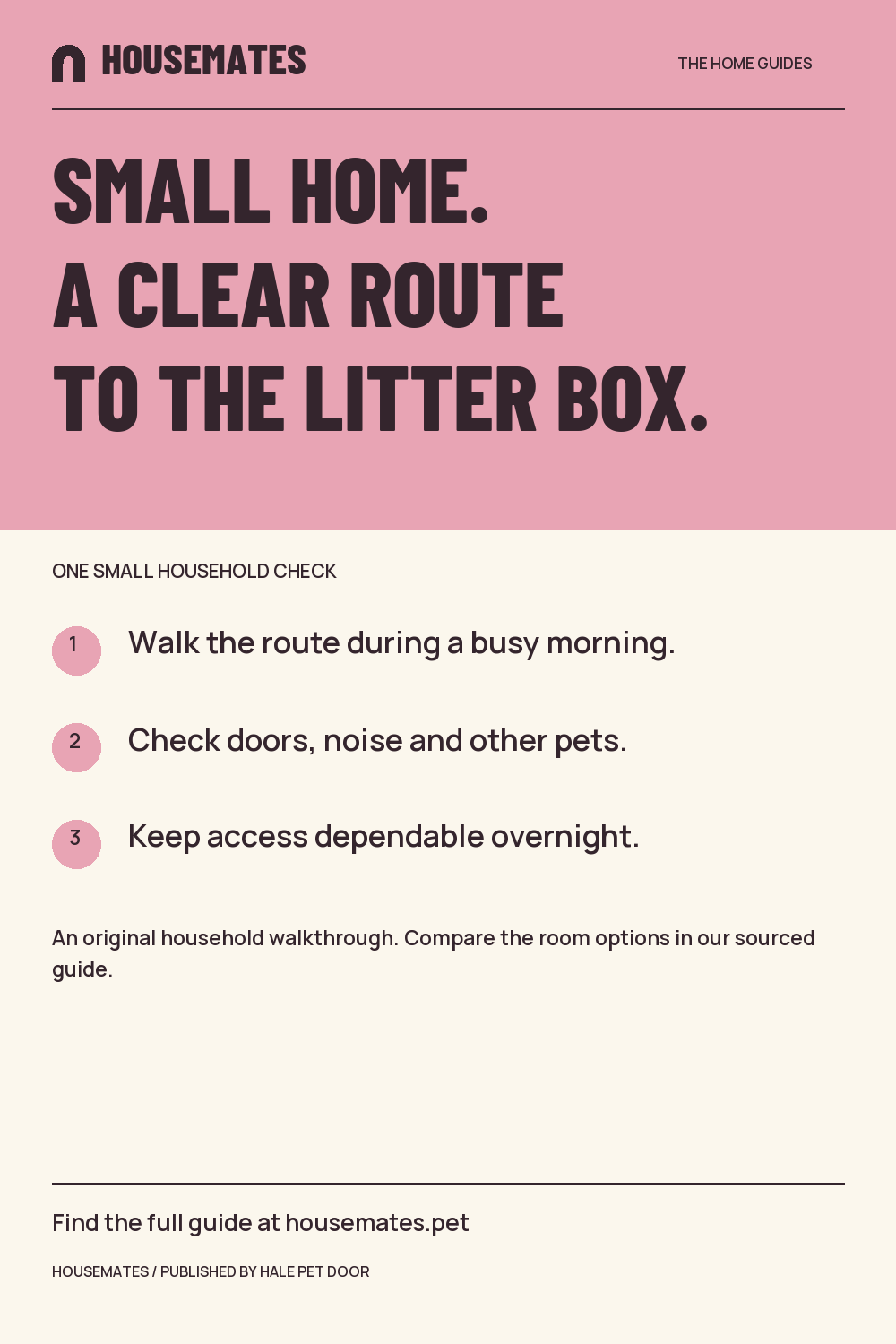
Before buying furniture to disguise the box, walk its proposed route at the times your household is busiest. Is a bedroom door usually closed at night? Does a laundry machine start beside it? Does a dog sleep across the approach? Mark those observations on a simple sketch. The usable route matters as much as the square of floor beneath the tray.
Compare three possible spots
| Possible location | What to check | Reason to reconsider |
|---|---|---|
| Bathroom | Access when someone showers, cleans or closes the door; dry standing room | The door is frequently shut or the box sits beside a noisy appliance |
| Bedroom edge | A quiet approach, room around the tray and a cleaning routine you can maintain | Furniture creates a dead-end approach or visitors block access |
| Living-room side area | Distance from bowls, television, walkways and another pet’s resting spot | The location is the household’s busiest crossing point |
These are comparison prompts, not a ranking of rooms. A calm living-room edge can be more usable than a bathroom that is repeatedly closed. A room name does not tell you how that space works through the day.
Small-apartment litter-box questions
Can I put the litter box in the bathroom?
A bathroom is a candidate if the cat can reach the tray whenever needed and has enough room to use it. Its name alone does not make it the best location. As a household rehearsal, run through a shower, a visitor using the room and your overnight routine. If any of those leave the only tray behind a closed door, choose a more dependable spot or resolve the access problem before relying on it.
Notice the actual noise, too. A washer starting beside the tray is different from a quiet bathroom with no appliance. Ohio State’s placement guidance advises quiet, easy access away from sudden appliance noise.
Can I hide the litter box inside furniture?
Check usable space, rather than whether a tray physically fits through the cabinet opening. Ohio State cautions against cramped locations such as under vanities or low tables, and notes that many cats prefer large uncovered trays. An enclosure is not automatically an improvement for the cat.
Our suggested check is to mark the inside clearance and entrance on paper, then compare them with the tray, the cat’s approach and the space needed to clean it. If hiding the tray requires a tight opening, an awkward turn or moving furniture for every scoop, reconsider the enclosure. This guide does not approve a particular cabinet or provide a cutting plan.
Where can a litter box go in a studio apartment?
Compare separate zones within the room instead of looking for a spare room you do not have. Sketch the bed, cooking area, bowls, door swings and regular walkways. Look for a quieter edge with enough room for the tray and a dependable approach, while keeping litter apart from food and water as Cats Protection recommends.
Then check the same sketch with the desk chair pulled out, the sofa bed open or a visitor’s bag on the floor. Those are illustrative household scenarios, not required features of a studio. If no arrangement keeps resources accessible, discuss your actual layout and the cat’s needs with the adoption organization or veterinary team. A smaller tray or a shared contested corner is not a universal solution.
Give the box its actual footprint
Put a paper outline of the proposed tray on the floor before committing to a location. Add the space needed for the cat’s approach and your own cleaning access. Open nearby drawers and doors. This little rehearsal can reveal a conflict that a product photograph misses.
Ohio State recommends enough room for the cat to stand and turn, notes that many cats prefer large uncovered boxes, and advises one box per cat plus one. In a multi-cat home, discuss resource placement with your veterinary team if space is difficult; simply lining every box up in one contested corner may not solve the access problem.
Make a location log
Use the free two-page route walkthrough to compare the space at three ordinary moments. Page one has a blank room sketch; page two has space for morning, evening and overnight arrangements, followed by the next step and a recheck. Use a separate copy for another candidate location. These are original Housemates planning prompts based on the access principles above.
- Map one location. Label the tray, bowls, door swings, furniture and regular walkways. Trace the approach and leave space for the person cleaning the tray.
- Circle the things that move. Mark chairs, doors, bags and other objects that change the available space. Note nearby appliances and where other pets usually rest.
- Describe three ordinary moments. Write what changed around the route, then whether it stayed open, was blocked or remains uncertain. Describe the arrangement rather than giving the cat or room a score.
- Choose one next step. Record the layout question, the responsible adult and when the household will check the arrangement again.
Rehearse proposed arrangements without the cat. Keep established resources accessible while considering options; do not close a door on the only tray to see what happens. Resolve an obvious obstruction immediately instead of waiting to finish the sheet. A note marked “open” records that observation only, not a promise that the location meets every need.
| Moment | What changes? | Useful note or next step |
|---|---|---|
| Morning | A work bag is left beside the bathroom door | The approach becomes narrow; agree another place for the bag |
| Evening | A desk chair is pulled into the route | Compare the route with the chair in its normal working position |
| Overnight | The door to the proposed spot is usually closed | Reconsider this location before relying on it |
This example illustrates the record; it is not a tested room design. Sketching a path does not tell you whether every cat can use it, whether equipment suits an individual animal or whether a persistent problem has a medical cause. Take unresolved access needs to the adoption organization or veterinary team.
Keep the sheet about the room: doors, objects, routes and agreed changes. Do not add addresses, entry codes or private care details. Label the finished location in your existing pet-sitter notes and explain which doors must remain accessible. A caregiver unfamiliar with the home should be able to find the route without guessing.
Do not turn a health change into a decorating project
A cat suddenly avoiding the box, appearing uncomfortable or changing its toileting pattern needs veterinary advice. A layout adjustment is not a diagnosis. Seek urgent veterinary help if the cat appears unable to pass urine. Keep your notes factual: what you observed, when it started and what changed in the home.
A useful finished plan has three parts: a suitable box, dependable access and a routine the household can maintain. Attractive storage can come later, once it works for the cat.
Sources & scope
Published by Hale Pet Door. Prepared with AI assistance and checked against the sources below; not reviewed by a veterinarian. Our planning exercises are original editorial suggestions. For individual health or behavior concerns, consult the appropriate qualified professional.
- Litter boxesThe Ohio State University Indoor Pet Initiative · Checked 2026-09-23
- Preparing your home for a catCats Protection · Checked 2026-09-23
- Feline lower urinary tract diseaseCornell Feline Health Center · Checked 2026-09-23